What Is Indicated by a Reading of Battery Voltage on the Ground Side of a Component
Electronic component symbols are used to denote the components in circuit diagrams. There are standard symbols for each of the components which correspond that item component. Here in this article, we are explaining some basic and more often than not used electronic components with their symbols.
Resistor:
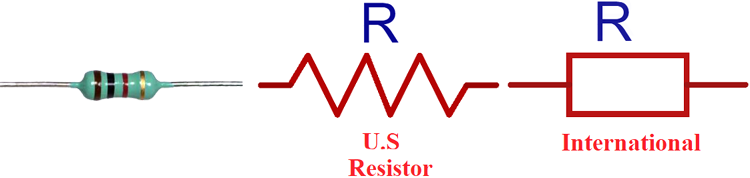
The resistor is a two-concluding component which is denoted pastR.Symbol of the resistor is represented by Zig-Zag lines between 2 terminals. Information technology is a common and widely used symbol in schematics. It can also be represented by another symbol that has an unfilled rectangle between two terminals instead of Zig-Zag lines. There are various types of resistors like a variable resistor, LDR, Thermistor, MOV, etc.
The resistor is a non-polarized component that ways both sides take the same polarity and tin can be connected from both sides. The value of the resistor is measured in ohms (Ώ).
Capacitor:
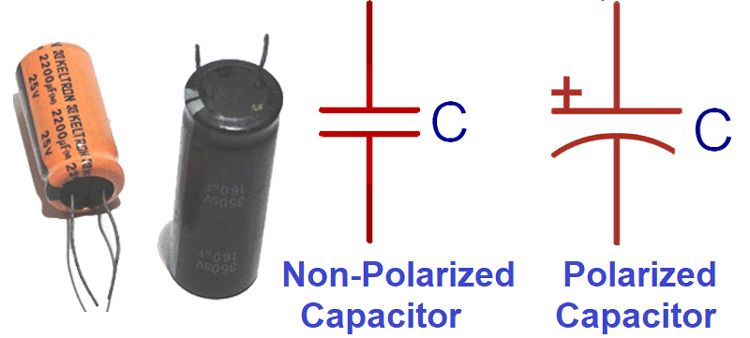
The capacitor is a two-terminal component denoted past C. Symbol of the capacitor looks like the two parallel plates are placed in between ii terminals. In the schematic, ii types of capacitor symbols are available. 1 is for a polarized capacitor and the other 1 is for the not-polarized capacitor. Learn more about capacitors here and check about various types of capacitors .
The divergence between both the symbols is that in the polarized capacitor symbol, one parallel plate has a curved shape. The curved plate represents the cathode of the capacitor and should exist at a lower voltage than the anode pivot (plane-parallel plate). The plane-parallel plate is the anode of the capacitor and is marked past plus (+) sign.
As the name indicates, a non-polarized capacitor tin be connected in two means but for polarized capacitor only specified i-way Connection is possible. The value of the capacitor is measured in farads (f).
Diode:
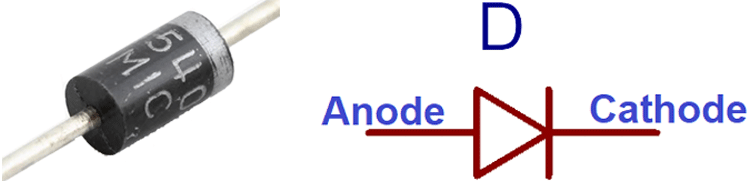
The diode is a polarized device with two terminals and denoted by D. In a diode, one last is positive (anode) and another one is negative (cathode). The closed side of a triangle is the cathode, and the base of a triangle is an anode.
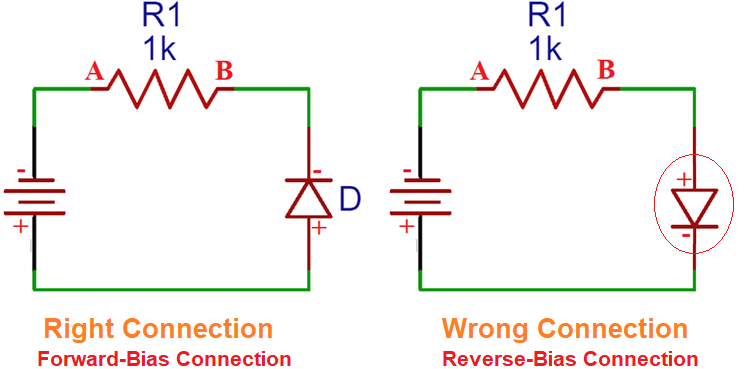
The symbol of a diode looks similar a horizontal isosceles triangle pressed up against a line between two terminals. The diode works in the frontwards bias or we can say that the diode will let the current flow in the forward bias condition.
Therefore, it is of import to note that the positive last (anode) of the diode is connected to the positive pole of the battery and negative pole (cathode) of the diode is connected to the negative last of the battery.
There are some other diodes with additional specifications and features explained beneath. Also, cheque diverse diodes and their working here .
Light Emitting Diode (LED):
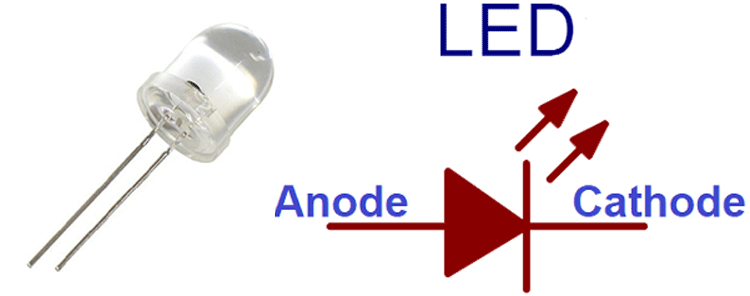
LED stands for light-emitting diode. The LED symbol is similar to the diode symbol with additional arrows. These arrows appear to point in the opposite direction of the triangle and seem to radiate from the triangle. LED is a polarized component with anode and cathode terminals.
Photodiode:
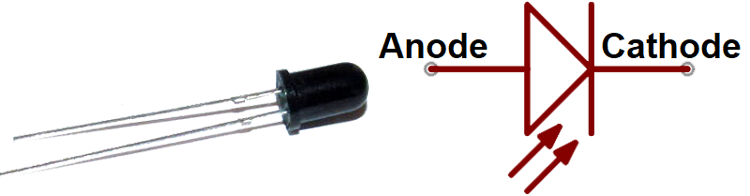
The symbol of the photodiode is similar to the LED Symbol except that information technology containsarrows hit the diode. Arrows striking the diode represent photons or low-cal. The photodiode has 2 terminals named anode and cathode. A photodiode is used to convert low-cal into electric electric current.
Zener Diode:
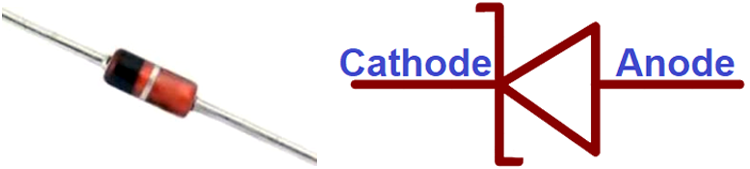
It is like to the normal forward diode; information technology also allows opposite current when the applied voltage reaches the breakdown voltage. The diode has a special, heavily doped P-N junction, which is designed to operate in the contrary direction when a certain specified voltage is reached.
Learn more than near it by going through various Zener Diodes.
Schottky Diode:
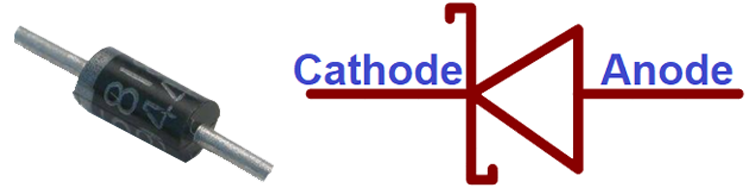
The Schottky diode has a lower forward voltage drop than the PN junction diode, and it is a metal-semiconductor diode. It can be used in high-speed switching applications. The Schottky diode is a unipolar device because it has electrons every bit majority carriers on both sides of the junction.
For this reason, electrons cannot menses across the Schottky bulwark. Under the forward biased condition, an electron nowadays on the N side receives more free energy to cantankerous the barrier and enter into the metal. Therefore, the diode is called a hot carrier diode. Due to this, the electrons are also called hot charge carriers.
Transistors:
In schematics, various transistors are available, either BJTs or MOSFETs. The transistor is a three-concluding device that amplifies or switches electronic signals and electrical power. We accept previously covered various Transistors with their symbols, pinouts, and specifications .
Bipolar Junction Transistor (BJT):
BJT is a bipolar transistor with three terminals: emitter (E), base of operations (B) and collector (C). For the BJT symbol, emitter and collector are arranged in a line and the base of operations is arranged vertically. There are two types of BJTs: NPN and PNP.
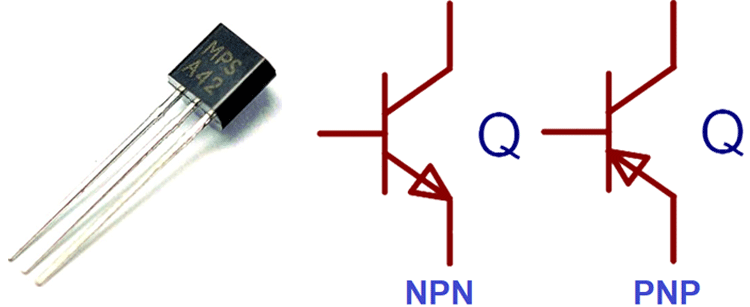
In the BJT symbol, the emitter has an arrow and the pointer'due south direction tells whether it's a PNP or NPN transistor. If the arrow points inward, information technology is a PNP, and if the arrow points outward, it is an NPN.
To remember the configuration you can learn it like this- "NPN: Northwardot Pointing In"
MOSFET:
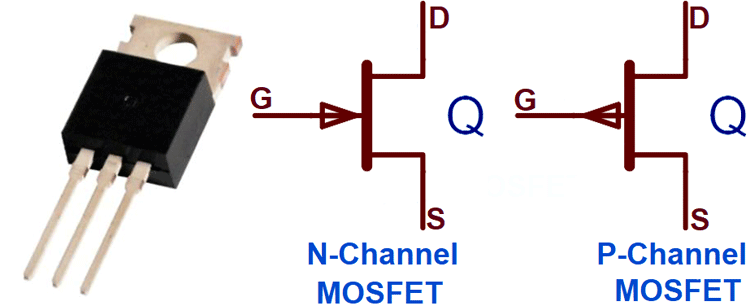
MOSFET stands for Metal Oxide Field Result Transistor and information technology has three terminals named Source (S), Bleed (D), and Gate (G). MOSFET has two types of symbols for northward-channel or p-channel MOSFET. Here you can larn about various types of MOSFETs .
Just similar BJT, in MOSFET, the direction of the arrow is used to distinguish between n-channel and p-aqueduct MOSFET. If the arrow at the center of the symbol is pointing IN, it is an n-aqueduct MOSFET and if the arrow is pointing OUT, it is a p-channel MOSFET.
You can remember the configuration similar this. "due north is IN"
Inductor:
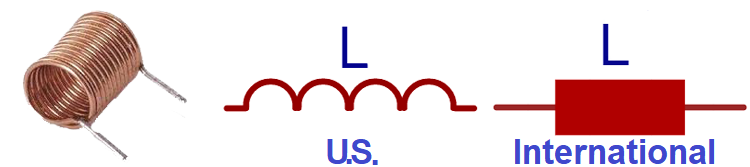
An inductor is a non-polarized two-terminal component. Inductor's Symbol contains loopy coils or curved bumps in between two terminals. The international symbol of an inductor considers a filled-in rectangle instead of loopy coils. An inductor is denoted past 'L' and the unit is Henry (H). Here are few Inductors with their pinouts and working .
Digital Logic Gates:
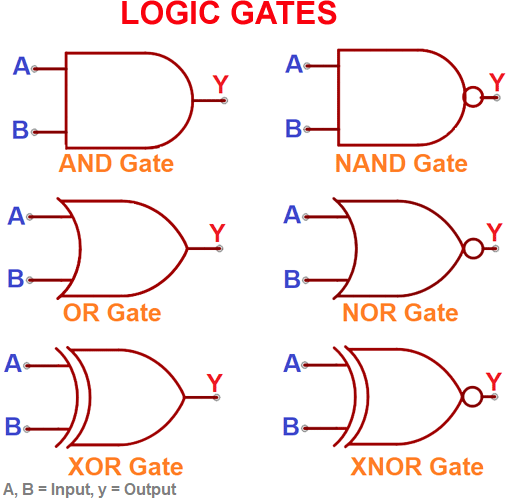
Logic gates are the fundamental edifice blocks of whatsoever digital system. Logic gates accept 2 inputs and one output however, the number of inputs tin can be changed every bit per the requirement while the output should exist the same.
Usually, there are 4 standard logic gates bachelor named AND, OR, XOR, and Non. Moreover, adding a bubble to the output negates the function and generates NANDs, NORs, and XNORs.
All the logic gates have a unique schematic symbol as shown beneath.
Switches:
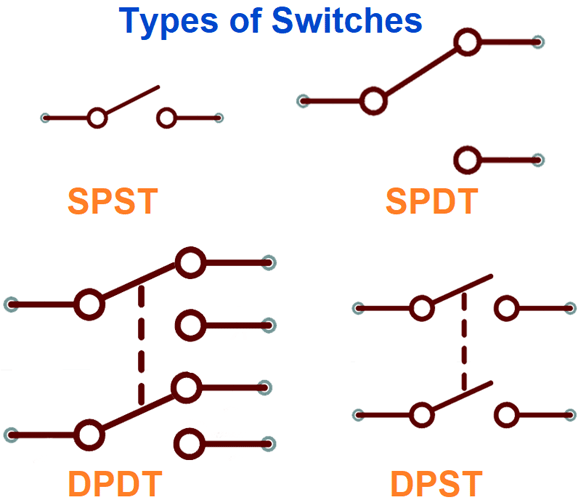
Switches are electronic devices designed to interrupt or divert the flow of electrical current or signals in a circuit. The simplest switch, a single-throw switch (SPST), consists of two terminals with a semi-connected pb representing the actuator.
In electronics, 4 types of switches are available named Unmarried Pole Single Throw Switch (SPST), Unmarried Pole Double Throw Switch (SPDT), Double Pole Unmarried Throw Switch (DPST), and Double Pole Double Throw Switch (DPDT).
All iv switches have different symbols, although the number of poles and throws changes in symbol co-ordinate to their name. Symbols are given beneath to clear the illustration.
Ability Sources:
The ability supply is an essential part of whatever electrical or electronic arrangement. While selecting an accurate power supply, various requirements must be considered.
At that place is a variety of ability supply excursion symbols that point the power source.
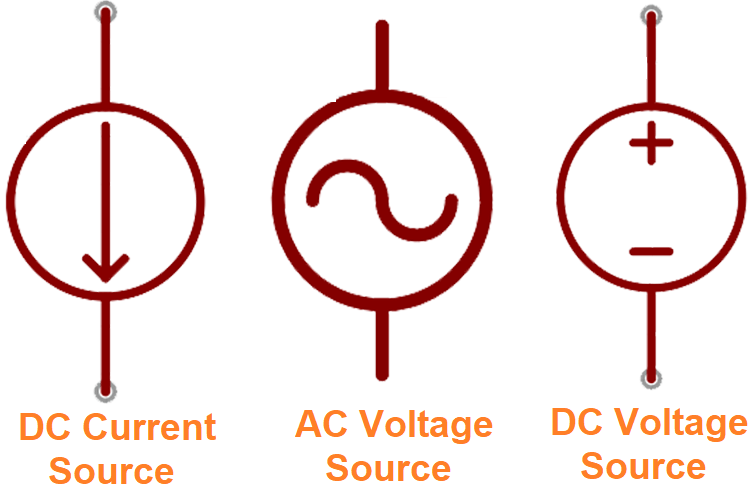
DC or Ac Voltage Source:
Generally, constant voltage sources are used while working with electronics. We can apply one of these two symbols to define if the source supplies Direct Current (DC) or Alternating Current (Air conditioning).
Batteries:
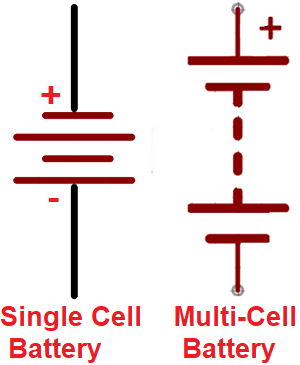
Instead of a constant voltage source, you can also use batteries. The battery symbol looks like a pair of disproportionate parallel lines, while more line pairs usually indicate more row cells in the bombardment.
Voltage Nodes:
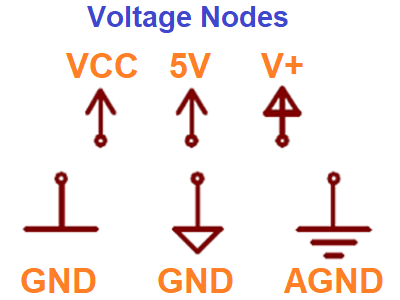
Voltage nodes are single-terminal schematic components that are used to announce power supply and can besides be connected to component terminals to specify a specific voltage level. The device can be directly connected to this one-terminal symbol which denotes 5V, 3.3V, VCC or GND (ground). Positive voltage nodes are usually indicated by an Up-pointing arrow, while ground nodes typically include one to 3 flat lines or sometimes down-pointing arrows or triangles equally shown in the image above.
Transformer:
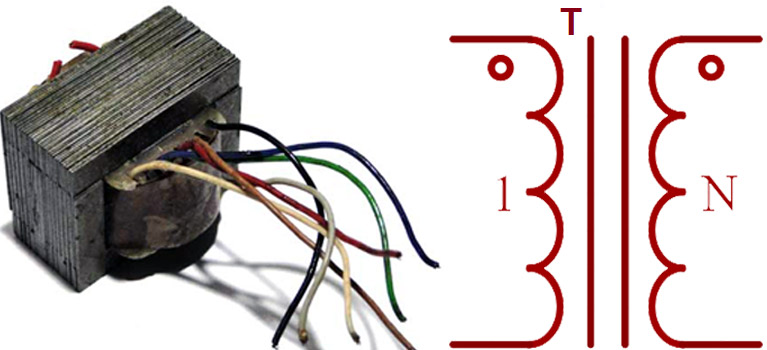
A transformer is a static device that transmits electrical free energy from one circuit to another through electromagnetic induction. The transformer symbol is denoted by two coils placed side by side, and separated by parallel lines. They are generally used to pace upwards or step down the voltage levels.
Relay:
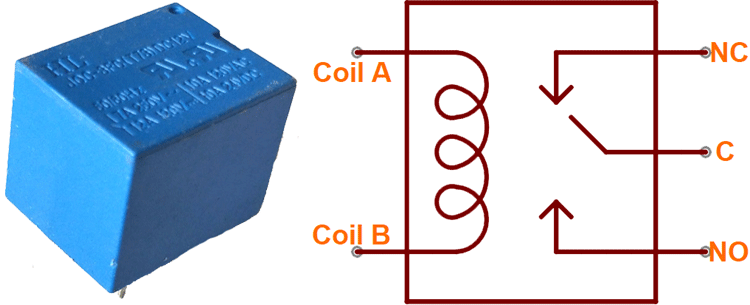
Relay is an electromagnetic switch that can be turned on with small-scale electrical current which further allows a large corporeality of electric current to flow from it. It usually pairs a coil with a switch which can be seen in the symbol itself.
The relay has 5 pins consisting of a pair of scroll pins, a common pin, a normally open pivot (NO), and a unremarkably airtight pin (NC). Nosotros previously covered a detailed article on Relay and its working .
Buzzer and Speaker:
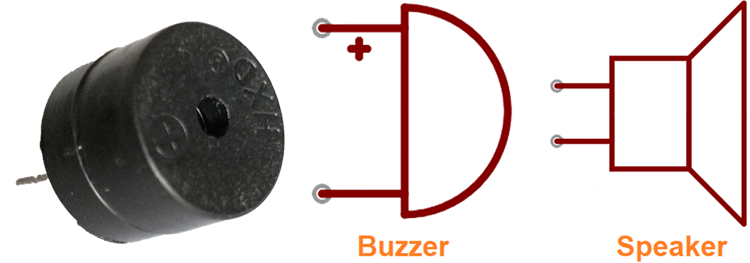
In buzzer, there is usually an oscillating transistor circuit, so it produces audio whenever a voltage is applied to it. The buzzer is a polarized component and can just be continued with a positive terminal to positive and negative to negative.
A speaker can play all kinds of audio. However, due to its integrated circuits, a cablegram is just able to compose the tone of the oscillator. Learn more well-nigh Buzzer and Speaker past following the links.
Motor:
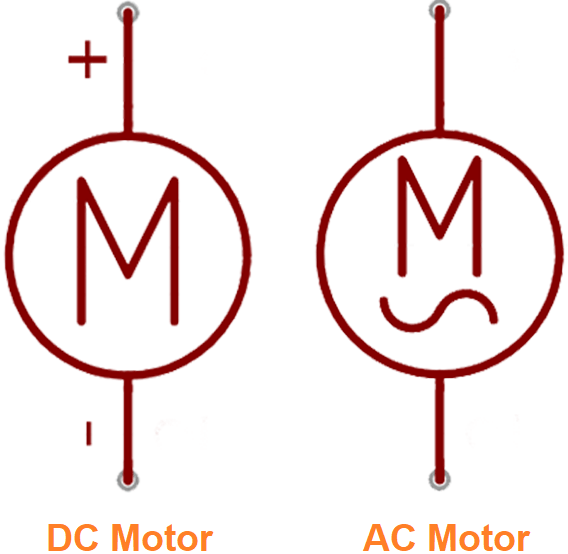
The motor is a transducer that converts electric free energy into kinetic free energy (motion). The motor symbol looks like an embellishment encircled 'M' effectually the terminals.
We have covered various types of motors with their symbol and working.
Fuse and PTCs:

A fuse or a PTC is an electrical prophylactic device that provides overcurrent protection for a circuit. The PTC symbol is actually the full general symbol for a thermistor.
Beneath table shows the unit, pin name and no of terminals of all the components we covered higher up:
| Component | Denoted by | Unit | Polarity/Pins | Terminals |
| Resistor | R | Ohms(Ώ) | Not | 2 |
| Capacitor | C | Farads(f) | Anode-Cathode | 2 |
| Diode | D | Anode-Cathode | 2 | |
| Inductor | 50 | Henry(H) | Not | 2 |
| Transistors(BJT) | NPN/PNP | - | Emitter, Base, Collector | 3 |
| Transistor(MOSFET | n-Aqueduct P-Channel | - | Drain, Source, Gate | 3 |
| Relay | - | - | NC, NO, C, 2-Scroll Pins | 5 |
| Power Sources | - | Voltage, Current | Positive, Negative | two |
| Motor | M | RPM | Positive, Negative | 2 |
So this is a beginner guide to learn about different types of basic electronic components, their symbols, and working.
Source: https://components101.com/articles/electronics-components-and-their-symbols
0 Response to "What Is Indicated by a Reading of Battery Voltage on the Ground Side of a Component"
Post a Comment